
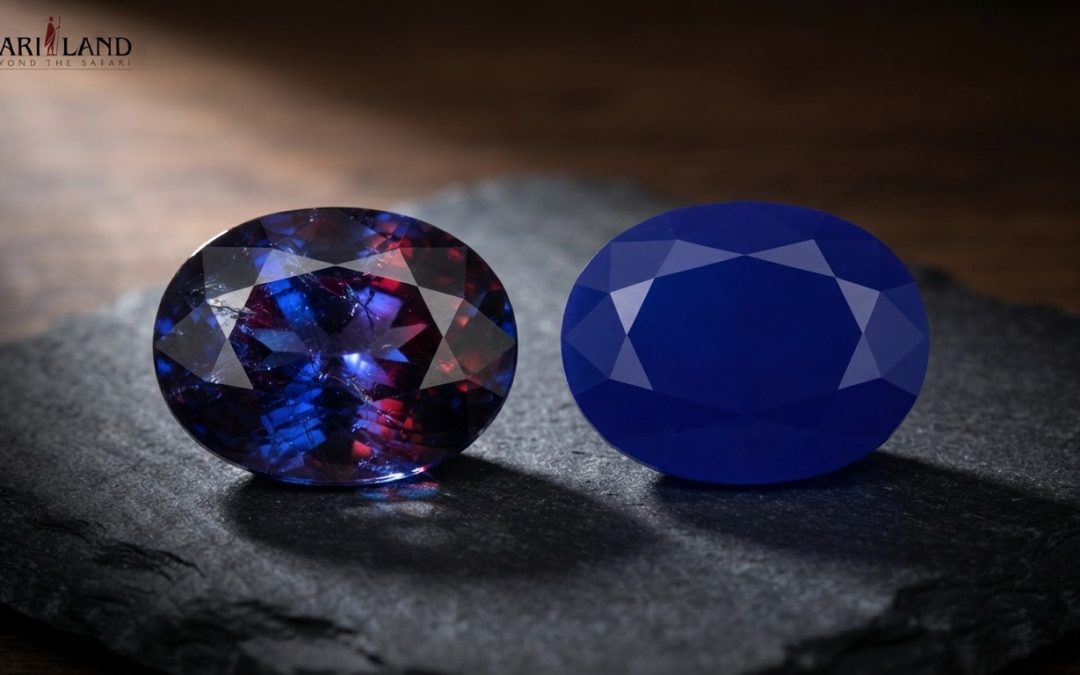
A customer walked into Safariland last year holding a “tanzanite” ring bought from an online marketplace for a fraction of what genuine stones cost. It wasn’t tanzanite at all, it was heat-treated zoisite mixed with synthetic colour enhancement, and she’d had no way of knowing until someone who actually handles the stone daily looked at it properly. That mix-up happens more often than people think, which is exactly why understanding what a Natural Tanzanite Stone actually is matters before buying one.
Where the confusion starts
Tanzanite is a blue-violet variety of the mineral zoisite, found in one location on earth, the Merelani Hills outside Arusha. Most rough tanzanite is brownish when it comes out of the ground and gets heat-treated to bring out that signature blue-violet colour, which is standard practice and doesn’t make a stone any less natural. The problem comes from stones that go further than heat treatment, ones that are dyed, coated, or entirely synthetic, sold under the tanzanite name to buyers who don’t know the difference.
What to actually check before buying
Colour zoning is one giveaway, a natural stone often shows subtle shifts in tone when tilted, while synthetic material tends to look uniformly perfect, which sounds like a good thing but usually isn’t. Price is another signal, genuine tanzanite from a reputable source rarely comes cheap given how limited the supply is, so a suspiciously low price on Tanzanite Jewelery is worth questioning rather than celebrating. Buying with a certificate from an independent lab, rather than just a receipt, gives an actual paper trail if the stone’s authenticity is ever in doubt.
Why the source matters as much as the stone
Every gram of genuine tanzanite traces back to the same small mining area near Kilimanjaro, which means sourcing directly from Tanzania carries a level of transparency that’s harder to get elsewhere. At African Gems & Jewelers, stones are sourced and cut close to where they’re mined, so buyers aren’t relying on a chain of resellers to vouch for what they’re getting. For anyone shopping for Unique Gemstone Engagement Rings, that traceability tends to matter more once they understand how easily the stone can be faked.
Getting a second opinion
Independent verification through a recognised lab such as the Gemological Institute of America is the most reliable way to confirm a stone before spending serious money on it. Grading reports cover treatment history, clarity, and origin where determinable, and they’re worth the small cost relative to what a fake stone would otherwise cost someone.
The trip changes how people see it
Buyers who visit Karatu to see tanzanite mining country tend to come away with a different relationship to the stone entirely, and most of them end up staying for the food as much as the gems. African Cuisine around this part of Tanzania is built on fresh, local ingredients rather than anything imported, and dishes served at Ol Mesera Restaurant give visitors a genuine taste of East African food most tourists never encounter back home. It rounds out the trip in a way a gem counter alone never could.
Conclusion
Authenticity isn’t something to guess at when a stone this rare is involved. A Natural Tanzanite Stone is worth exactly what its rarity and certification say it’s worth, nothing more once the marketing is stripped away, and a few careful checks before buying can be the difference between a genuine piece and an expensive mistake.
Buying with confidence
Checking colour zoning, asking for certification, and buying from a source close to the mine are the three things that separate a genuine purchase from a costly one. Seeing the stone near where it’s mined, and tasting the region’s food along the way, tends to make the whole trip worth more than the gem itself.
FAQs
How can I tell if a tanzanite stone is natural?
Check for subtle colour zoning when the stone is tilted, ask for an independent certification, and be cautious of prices that seem too low.
Is heat-treated tanzanite still considered natural?
Yes, heat treatment to enhance colour is standard practice in the trade and doesn’t make a stone synthetic or fake.
Why does tanzanite vary so much in price?
Colour saturation, clarity, and certification all affect price, along with the fact that all tanzanite comes from a single, limited source.
Should I get a certificate when buying tanzanite jewellery?
Yes, a certificate from a recognised lab gives a documented record of the stone’s authenticity and treatment history.