
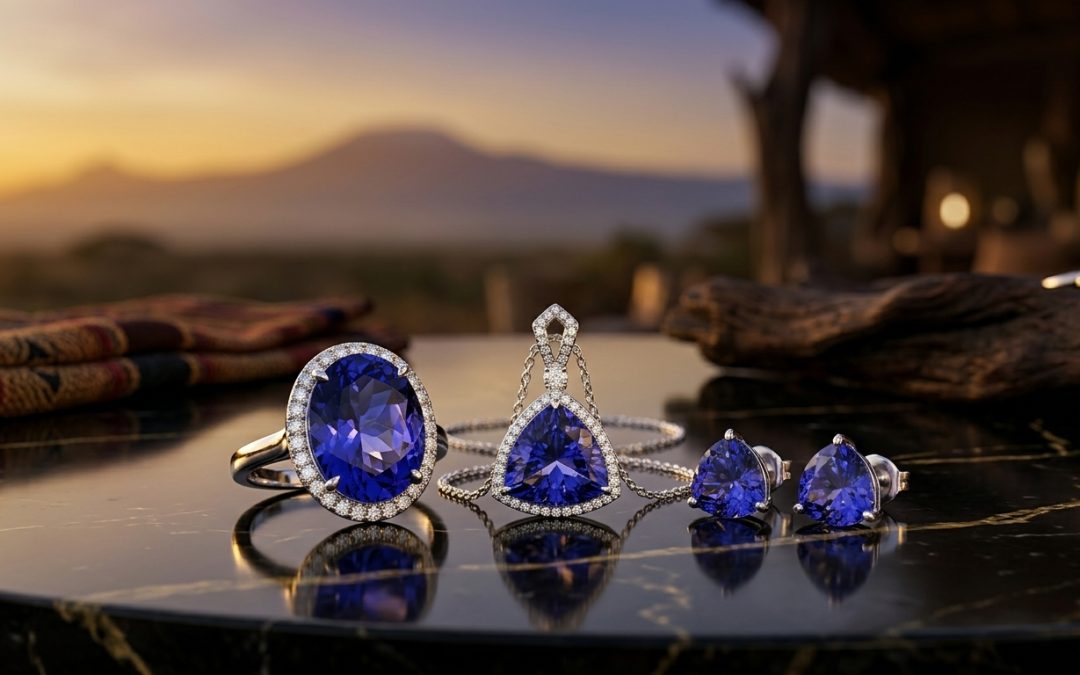
Most people buying tanzanite jewellery do it thousands of miles from where the stone came out of the ground. That’s fine — but it does mean you’re trusting a chain of hands you can’t see.
Tanzania is the only place on Earth tanzanite exists. A narrow strip of land near the foothills of Mount Kilimanjaro in the north of the country is the sole source — no deposits have ever been found anywhere else. Supply is finite and getting smaller. What that means practically is that buying here, at the source, is a different thing to buying it in a shop in London or Cape Town.
What You’re Actually Buying
Tanzanite is trichroic — tilt it under different light and it moves between deep blue, violet, and sometimes burgundy. No two stones look the same. The deeper and more saturated the colour, the rarer and more valuable the piece. Stones under three carats tend to run lighter; the really rich tones usually appear in larger specimens.
Heat treatment is standard and universally accepted. Rough tanzanite comes out of the ground brownish. Gentle heating is what brings out the blue-violet. Any seller pitching “unheated” stones as a premium is being creative with the truth — there’s currently no test that can confirm it either way.
The Gemological Institute of America recommends independent certification for any significant purchase: colour grade, carat weight, cut, and clarity. Ask for it. A reputable seller won’t hesitate.
Tanzanite Engagement Rings — Honest Take
More couples are choosing tanzanite engagement rings instead of diamonds, and the reasons are sensible. The colour is unlike anything else — blue sapphire comes close but lacks the violet depth. Price per carat is considerably lower for equivalent quality.
The honest part: tanzanite sits at 6.5 to 7 on the Mohs hardness scale, softer than sapphire or diamond. It’s not fragile, but it asks for a bit more care. A protective setting — bezel or halo — helps. So does taking it off before anything rough. For someone who treats their jewellery thoughtfully, it’s a genuinely good choice.
At Africa Gems & Jewelers at Safariland, custom rings are designed and crafted on-site. You choose the stone, the setting, the metal. The jewellers work with you directly — and you’re doing it in Tanzania, where the stone actually comes from.
Loose Tanzanite Stones
If you’d rather have a stone assessed independently before it’s set, buying loose tanzanite stones makes sense. You get full control over the design and the peace of mind of knowing exactly what you’re working with before committing to a setting.
Conclusion
Tanzanite jewellery bought in Tanzania carries something no retailer abroad can replicate — traceability, local craftsmanship, and the simple fact that you’re as close to the source as it’s possible to get. Whether you’re after a custom tanzanite engagement ring, loose tanzanite stones to set later, or a finished piece to take home, Safariland’s Africa Gems & Jewelers offers all of it in one place. Visit us near Karatu, between the Ngorongoro Crater and Lake Manyara, and see the stones for yourself.
FAQs
Is tanzanite jewellery a good investment?
High-grade tanzanite with deep colour saturation has increased in value as supply has reduced. It’s not a guaranteed financial asset, but quality stones bought at the source tend to hold and grow in value over time. Buy it because you love it — the investment case is a reasonable bonus.
Are tanzanite engagement rings durable enough for daily wear?
With a protective setting and a bit of care, yes. Remove the ring before gym sessions or heavy work, and clean it with warm soapy water rather than ultrasonic cleaners. The stone is not fragile — it just rewards being treated thoughtfully.
How do I know if tanzanite is authentic?
Genuine tanzanite shifts colour under different lighting — blue, violet, sometimes burgundy. Fakes made from glass or cubic zirconia show only a flat single colour. Always request a certificate of authenticity and buy from a source with clear, traceable provenance.