
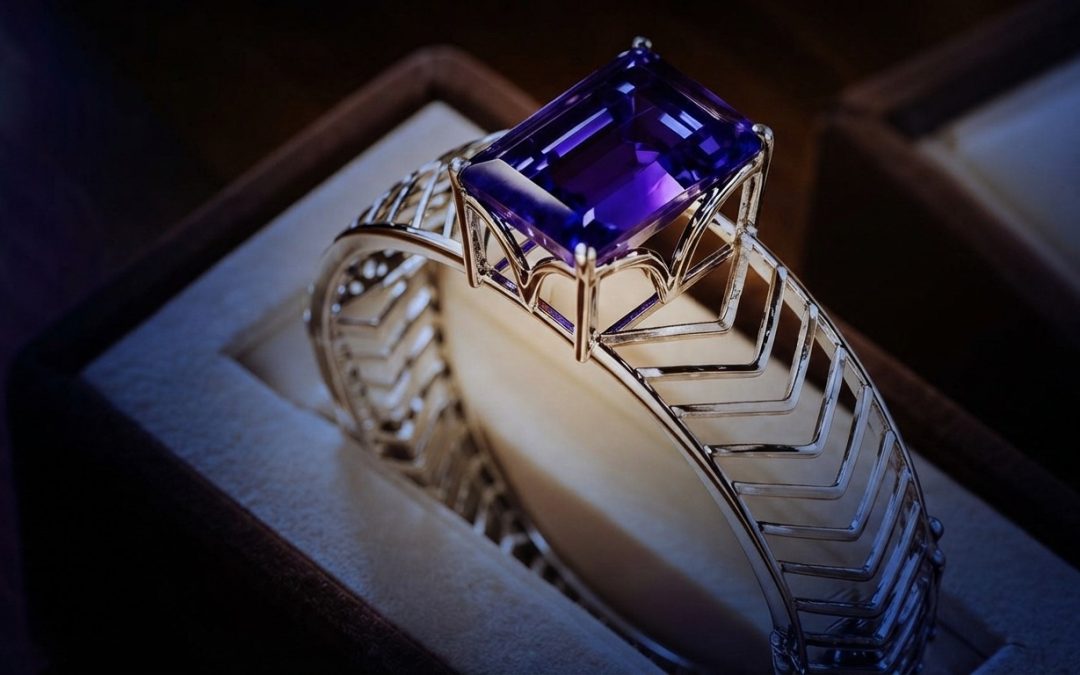
I’ve watched a fair few proposals happen in our gallery, and the ones with tanzanite always play out the same way. The partner tilts the ring under the light, sees it shift from blue to violet and back again, and there’s this pause — a proper one, not a polite one. That reaction is basically the whole pitch for tanzanite as an engagement ring.
More couples are stepping away from diamonds these days, and it’s not really about cost. It’s about wanting something that says a bit more than “this is what everyone buys.” A diamond is beautiful, no argument there, but it’s also the default. Tanzanite isn’t anyone’s default. Fewer than one in a hundred people getting engaged will ever put a tanzanite ring on their partner’s finger, mostly because most people don’t know the option exists.
That colour shift is the whole point
Gemologists call it pleochroism — the stone shows different colours depending on the angle you view it from and the light hitting it. Under daylight it leans blue. Under warmer indoor light, more violet. It’s not a trick or a treatment; it’s just how the crystal structure bends light. Practically, it means the ring never looks quite the same twice, which honestly suits an engagement ring better than a stone that’s identical from every angle for the next fifty years.
Choosing a setting that’ll survive daily life
This is where I’d steer most couples toward a protective setting — bezel or half-bezel, something that wraps the edge of the stone rather than leaving it fully exposed like a classic diamond solitaire. It’s not about hiding the colour; a well-cut tanzanite still shows plenty through a bezel. It’s about the ring surviving gardening, gym bags, washing up, all the small daily knocks a hand takes.
Is it actually durable enough?
Fair question, and worth answering honestly rather than glossing over. Tanzanite sits at around 6 to 7 on the Mohs hardness scale, softer than diamond’s 10 and sapphire’s 9. That doesn’t mean it’s fragile — it means it needs a bit more consideration in the setting and a bit more care day to day than a diamond would. Take it off before anything physical. Get the setting checked once a year. Treat it the way you’d treat any stone that isn’t the hardest thing in the room, and it’ll hold up fine for decades. GIA’s own material on tanzanite’s hardness and durability is worth reading if you want the numbers rather than taking a jeweller’s word for it.
The story becomes part of the proposal
Here’s the bit most people don’t expect: because tanzanite only comes from one place on Earth, near Mount Kilimanjaro, there’s an actual story attached to the stone before you’ve even said a word. A few couples we’ve worked with have built the proposal around that — mentioning where the stone came from, sometimes even proposing having visited the mine themselves during a trip to Tanzania. It gives the moment a second layer that a diamond, mined from wherever a diamond happens to be mined that decade, just doesn’t carry.
Building a ring around one stone
If you go custom, which a lot of couples do, the process starts with the natural tanzanite stone itself — picking one specific, ethically sourced piece, then designing the setting around its individual colour and cut rather than fitting it into a template. It takes longer than buying off a shelf. Most people who’ve done it will tell you it’s worth the wait.
Want to see what makes each stone different before you commit to one? Come look through Safariland’s collection, or book a gem tour and see where the whole story actually starts.
FAQ
Why are couples choosing tanzanite over diamonds for engagement rings?
Mostly for individuality. Diamonds are the expected choice; tanzanite’s colour shift and single-source rarity give couples something that feels more personal and far less common.
Is tanzanite too soft for an engagement ring worn every day?
It’s softer than diamond but not fragile. A protective setting and a bit of routine care — taking it off for anything physical, an annual check — is usually all it needs.
What does the colour-shifting quality actually look like?
The stone shifts between blue and violet depending on the light and the angle you’re viewing it from. It’s a natural optical effect, not a treatment, so no two viewings look quite identical.
Can I have a tanzanite engagement ring custom-made?
Yes, and many couples do. You choose a single ethically sourced stone first, then the setting is designed around that specific stone’s colour and cut.
Does the story behind tanzanite matter for a proposal?
For a lot of couples, yes. Because the stone only comes from one place near Mount Kilimanjaro, it carries a genuine origin story that a diamond typically doesn’t.