
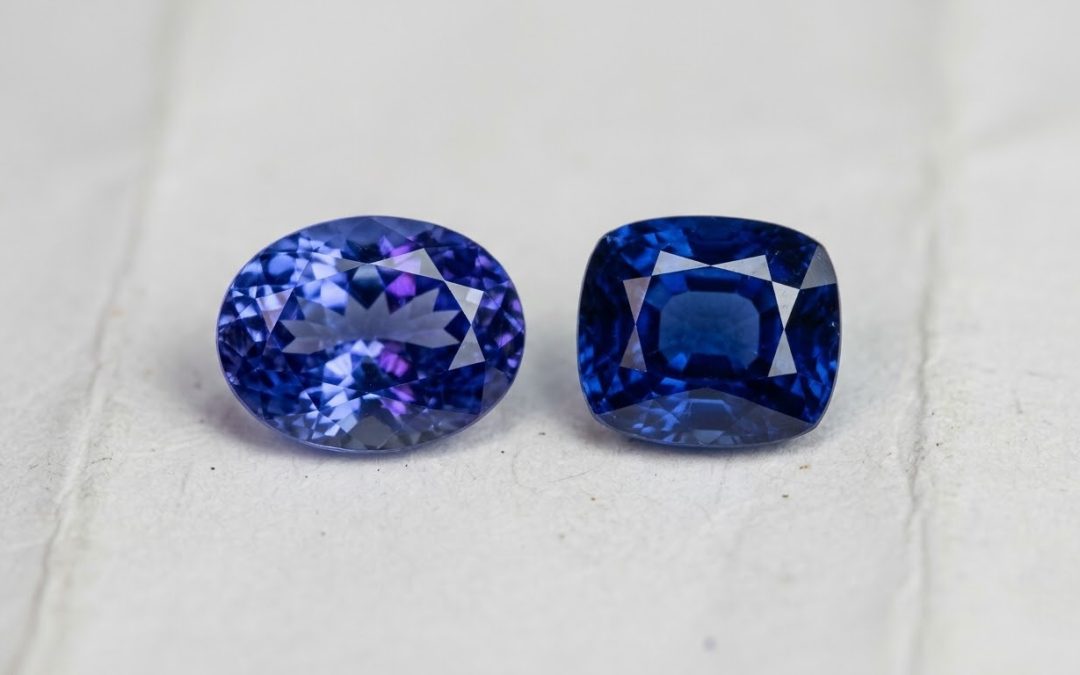
Somebody asks me about this most weeks. They've seen a blue stone in a window back home, or a friend has a ring they can't place, and they want to know: is it tanzanite or sapphire, and which one should I buy? Fair question. Lay a good tanzanite next to a good blue sapphire and most people can't tell. I couldn't, the first time.
So this is my take on tanzanite vs sapphire, from behind a counter in Karatu. Short version: neither one is better. They suit different people.
Two different minerals
They look alike, but they aren't related. Sapphire is corundum, the same mineral as ruby, and it's dug up all over the place: Sri Lanka, Madagascar, Australia, Thailand, and here in Tanzania as well, funnily enough. People have been wearing it for thousands of years.
Tanzanite is a type of zoisite, and it comes from one spot only, the Merelani Hills outside Arusha. Nobody knew it existed until 1967. So you've got one stone with an ancient history and one that's younger than most people's parents.
Watch what the colour does
This is where you start being able to tell them apart. Sapphire's blue mostly stays put. Tilt it and it gets brighter or darker, but it's still blue.
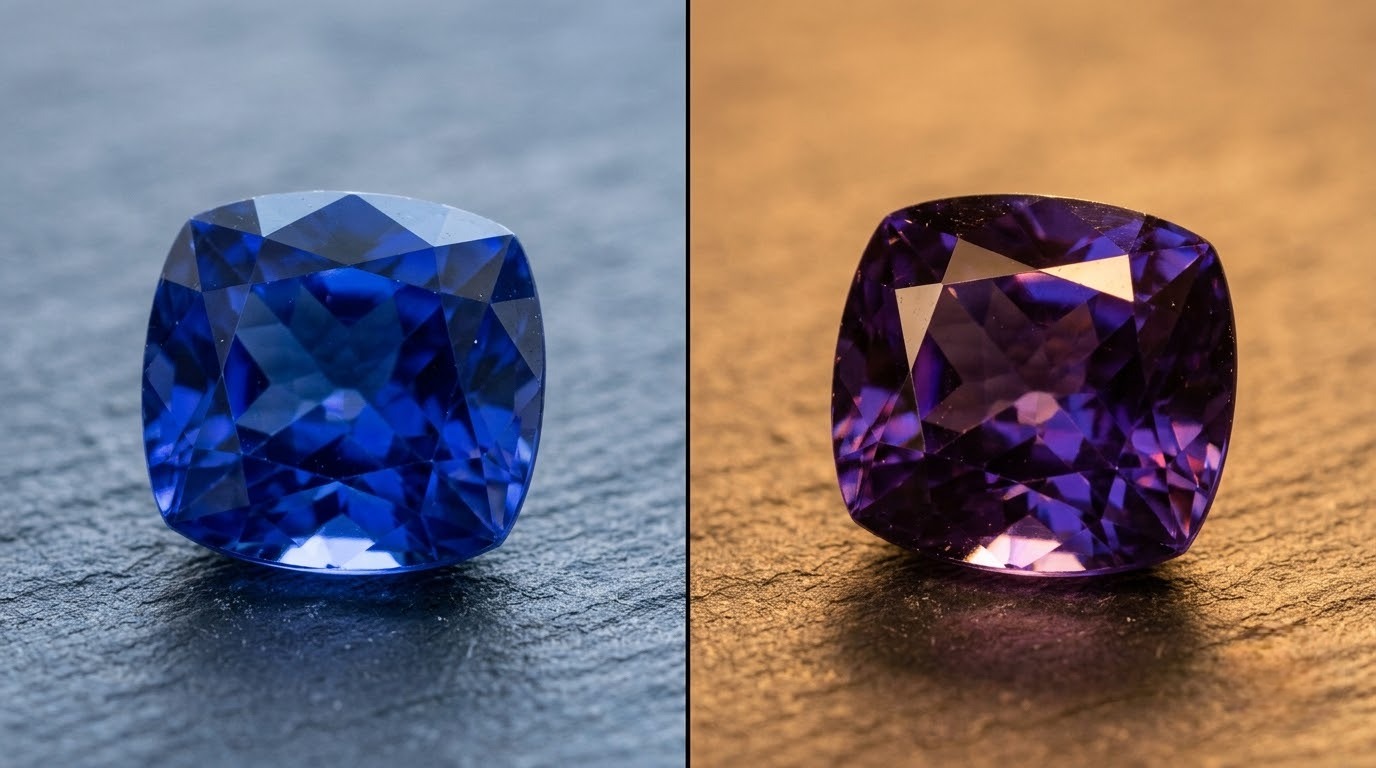
Tanzanite doesn't sit still. It's trichroic, meaning the crystal shows different colours depending on which way you look through it. Blue one way, violet another, and sometimes a hint of something reddish or bronze. Once it's cut, you mainly see it flick between blue and violet as it moves. Under a warm lamp it goes noticeably more purple. If the stone in your hand keeps flashing violet at you, my money's on tanzanite.
Hardness, which matters more than people think
I'd put this above colour, honestly, if you're buying something to wear every day. Sapphire scores 9 on the Mohs scale. Only diamond beats it among the stones you'll see in a jeweller's. You can knock it about and it'll shrug it off.
Tanzanite is about 6 to 6.5. That's fine for jewellery, and plenty of people wear it daily, but a hard knock can chip it or scratch it. It also doesn't love sudden changes in temperature, and you shouldn't put it in an ultrasonic cleaner. None of that rules out a tanzanite ring. It just means you choose the setting carefully and take it off before you go and dig the garden.
The two side by side
| What to compare | Tanzanite | Blue sapphire |
|---|---|---|
| Mineral | Zoisite | Corundum |
| Where it's found | Only near Arusha, Tanzania | Many countries |
| Colour | Flicks between blue and violet | Mostly steady blue |
| Hardness (Mohs) | About 6 to 6.5 | 9 |
| Everyday rings | Fine with a protective setting | Very well suited |
| Treatment | Usually heat-treated | Often heat-treated |
| History | Found in 1967 | Worn for thousands of years |
Telling them apart without a lab
You can't be certain without proper gem testing. I want to be clear about that. But there are a few things anyone can do in a shop.
Hold the stone under one light and tilt it slowly. A blue-to-violet flicker points to tanzanite. Steady blue points to sapphire. Then look at it in daylight, and again under a warm indoor bulb. Tanzanite tends to shift towards purple indoors in a way sapphire doesn't.
And then ask. What is it? Where's it from? Has it been treated? Can I have that in writing? A decent seller answers all four without fuss.
On treatment, by the way, don't panic. Nearly all tanzanite is gently heated to bring out the blue, and a lot of sapphire is heated too. That's normal in both trades. You're not trying to avoid treatment. You're trying to make sure you're told about it. Our guide on how to tell if tanzanite is the real thing goes into more detail.
What the metal does to each one
Sapphire is easygoing. Put it in white gold, yellow gold, platinum, whatever, and it looks like sapphire.
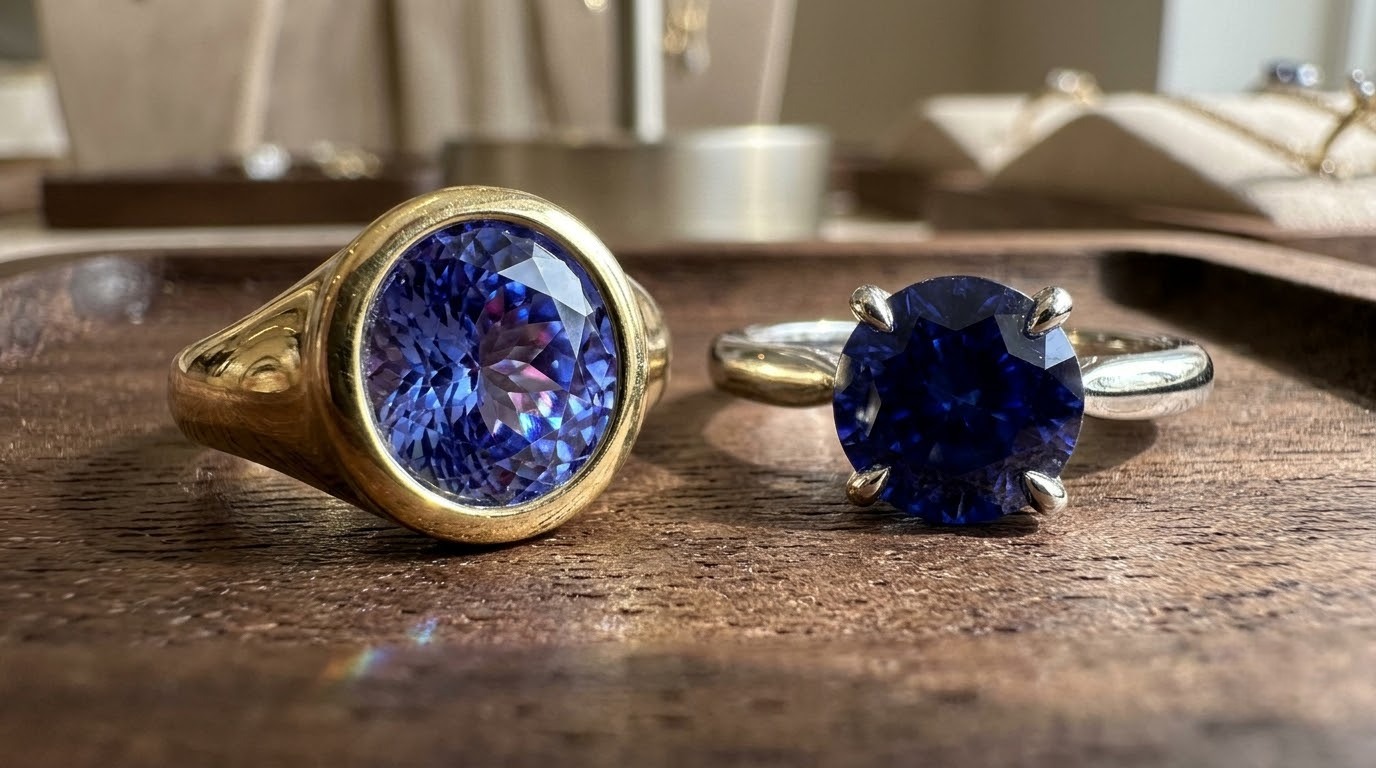
Tanzanite is fussier, in a good way. In white gold or platinum it reads cooler and bluer. Yellow or rose gold pulls the violet forward. A ring of little diamonds around it makes it look brighter and more blue, and without them you notice the purple more. If you're having something made, ask to hold the loose stone against a couple of different metals first. It's surprising how much it changes.
Looking after them
Sapphire is no trouble. Warm soapy water and a soft brush, and most jewellers will happily put it through an ultrasonic.
Tanzanite wants a bit more thought. Clean it by hand only, warm water and mild soap. No ultrasonic, no steam. Keep it in its own little bag so harder stones don't scratch it, and take rings off for the gym or anything heavy. Do that and it'll outlast you.
So which should you buy?
If it's an engagement ring that's going to be worn every single day for forty years, often without a second thought, I'd lean towards sapphire. It's more forgiving, and that counts for a lot.
If you love that violet edge, or you like the idea of a stone that only comes from one place, or it's a pendant or earrings where hardness hardly matters, tanzanite is a lovely choice. It's also a December birthstone, and if you're buying it in Tanzania, it comes home with a story.
I won't give you a price comparison, because there isn't a fair one. A top tanzanite can cost more than an average sapphire and the other way round. Compare the actual stones in front of you, not the names on the labels.
Watch out for fakes
Both get copied. Blue glass and synthetics turn up passed off as tanzanite, especially on tourist routes, and lab-made sapphire is everywhere in cheap jewellery. If the price makes you blink, there's usually a reason.
Here in Tanzania, be wary of anyone offering you loose or rough tanzanite at the roadside or outside your hotel. I've lost count of the visitors who paid good money for coloured glass. Buy from a jeweller with a proper shop and a receipt. It's worth the extra stop.
See it where it's mined
If you're up in northern Tanzania anyway, it's worth seeing tanzanite properly before you decide on anything. Africa Gems & Jewelers at Safariland near Karatu runs the Tanzanite Tour, which takes you from the mining side through to finished jewellery. Seeing a whole range of stones together, pale ones next to deep ones, makes the colour differences click in a way photos never do.
Before you come, have a look at why tanzanite jewellery is so rare and how to buy it right and what to expect on a tanzanite gem tour.
Frequently asked questions
What's the main difference between tanzanite and sapphire?
Tanzanite flicks between blue and violet and is softer, about 6 to 6.5 on the Mohs scale. Sapphire holds a steadier blue and is much harder, at 9.
Is tanzanite a kind of sapphire?
No. Tanzanite is zoisite and sapphire is corundum. They happen to look alike.
Tanzanite or sapphire for an engagement ring?
Sapphire copes better with years of daily wear. Tanzanite works too if it has a protective setting and a bit of care.
Where can I see tanzanite in Tanzania?
Africa Gems & Jewelers at Safariland near Karatu runs the Tanzanite Tour, from the mining side through to finished jewellery.
Compare Tanzanite vs Sapphire for Yourself
The tanzanite vs sapphire choice is much easier with the stones in your hand. Join the Tanzanite Tour at Africa Gems & Jewelers at Safariland near Karatu and see tanzanite a short drive from where it's mined.
Book the Tanzanite Tour